Change Requests
Change requests are submitted through the Request Services page under the Change Requests category. All changes to systems within the authorization boundary must be formally documented through a change request to maintain compliance with FedRAMP and CMMC change management requirements.
Change Request Form
The change request form captures the full scope of a proposed change, including its type, category, justification, risk assessment, and implementation plan.
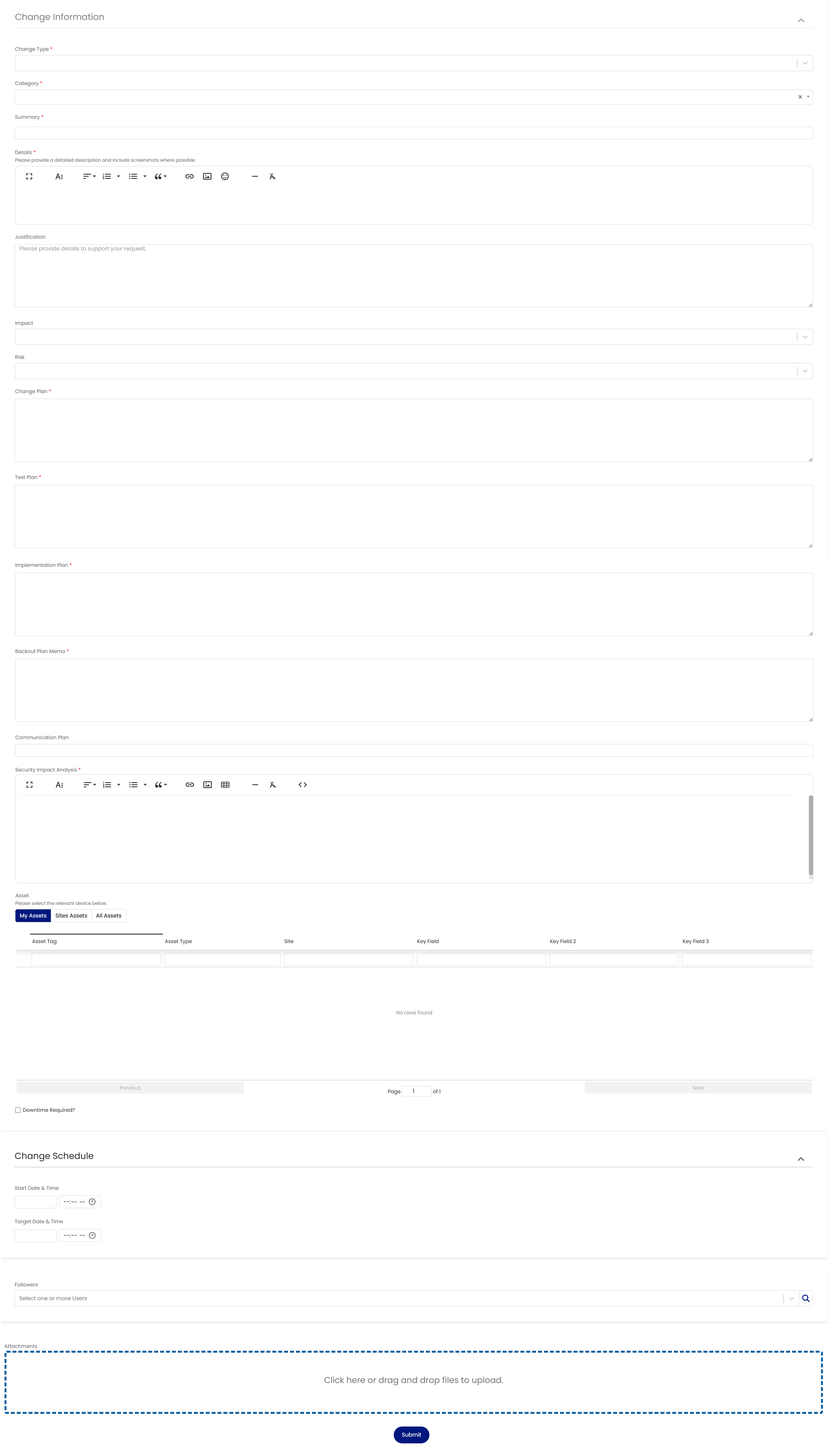
Form Fields
| Field | Purpose |
|---|---|
| Change Type | Classifies the nature of the change (see below). Required when you request approval |
| Change Type Explanation | Why you chose this type. Required when you request approval |
| Emergency | Yes or No. Choose Yes when the change must happen immediately to address an active incident, outage, or zero-day |
| Category | Identifies the operational domain and specific activity (see below) |
| Summary | Brief description of what is being changed |
| Impact | Rich text field to describe the scope of impact on systems, users, and services |
| Justification | Why this change is necessary, tying back to compliance requirements, security findings, or operational needs |
| Risk | Assessment of risk associated with the change |
| Change Plan | Step-by-step description of how the change will be executed |
| Test Plan | How the change will be validated after implementation |
| Implementation Plan | Detailed execution plan including sequencing and dependencies |
| Backout Plan / Rollback | Steps to reverse the change if issues arise during or after implementation |
| Communication Plan | Who needs to be notified before, during, and after the change |
| Affected Assets | Systems, components, or infrastructure impacted by the change (select from the asset inventory) |
| Change Schedule | Start date/time, target completion date/time, and estimated duration |
Change Types
The Change Type field classifies the nature of the change being requested. Selecting the correct type ensures proper review, approval routing, and audit documentation. A request with no Change Type or no Change Type Explanation is refused at approval.
| Change Type | Description | Compliance Context |
|---|---|---|
| Routine Recurring | Pre-approved, regularly scheduled changes such as patching cycles or certificate renewals | Supports FedRAMP CM-3 and CMMC CM.L2-3.4.3 by establishing predictable, documented change patterns that auditors can verify |
| Adaptive | Changes made in response to environmental shifts such as vendor updates, dependency upgrades, or infrastructure adjustments | Aligns with FedRAMP CM-4 (impact analysis); requires assessment of how external changes affect the security posture |
| Transformative | Significant architectural or functional changes such as new service deployments, major upgrades, or boundary modifications | May constitute a FedRAMP Significant Change requiring notification and potentially reassessment under the continuous monitoring program |
| Certification Class Change | Changes likely to alter the FedRAMP Certification class of the entire offering (for example Class B to Class C) | Cannot proceed under the Significant Change Notification rules; requires a new assessment |
| Impact Categorization | Legacy -- retained so historical change requests keep their original classification. For new changes affecting the offering's class, use Certification Class Change | Not used for new changes |
| Interim Requirement | Changes driven by interim compliance directives, binding operational directives (BODs), or emergency security guidance | Supports timely response to CISA BODs and FedRAMP PMO directives that require action within defined timeframes |
Emergency is a field, not a type
Any change type can be an emergency. Set the Emergency field to Yes for critical changes that must be implemented immediately. FedRAMP CM-3 allows emergency changes with expedited approval but requires full documentation after the fact. Emergency changes skip the advance-notice steps, and the agent sends the required notice afterward.
Categories
The Category field identifies the operational domain and specific activity for the change. This categorization supports accurate reporting and audit trail requirements.
Continuous Monitoring
| Category | Description |
|---|---|
| Flaw Remediation | Patching, vulnerability remediation, and security fixes identified through scanning or assessment. Directly supports FedRAMP SI-2 and CMMC SI.L2-3.14.1 flaw remediation requirements |
Engineering
| Category | Description |
|---|---|
| Configuration | Changes to system settings, security baselines, or hardening configurations. Supports FedRAMP CM-6 and CMMC CM.L2-3.4.2 security configuration settings requirements |
| Deployment | Deploying new components, services, or infrastructure within the authorization boundary |
| Development | Code changes, feature development, or application modifications within the system |
| Maintenance | Scheduled system maintenance, hardware replacements, or infrastructure upkeep. Supports FedRAMP MA-2 controlled maintenance requirements |
| Testing | Security testing, penetration testing, or validation activities that may affect production systems |
Approval Workflow
Change requests follow the approval workflow described in the Approvals section: the Change Request Approvers CAB reviews and approves first, and when your organization has a designated end user with the Change Approver role, the request is then forwarded to them for final sign-off. Approval processes can be customized to suit your organization's needs.
For Adaptive and Transformative changes, an agent sends the required FedRAMP notices at set steps of the change. You do not send them. See FedRAMP Notices for how they work.